 Digital Onboarding
  AML
AML  Credit Analysis
  Card Issuance
  Payment Dispersion
  Notifications
  Collections
  Bill Payment
  Alternative Scoring
  Device Lock
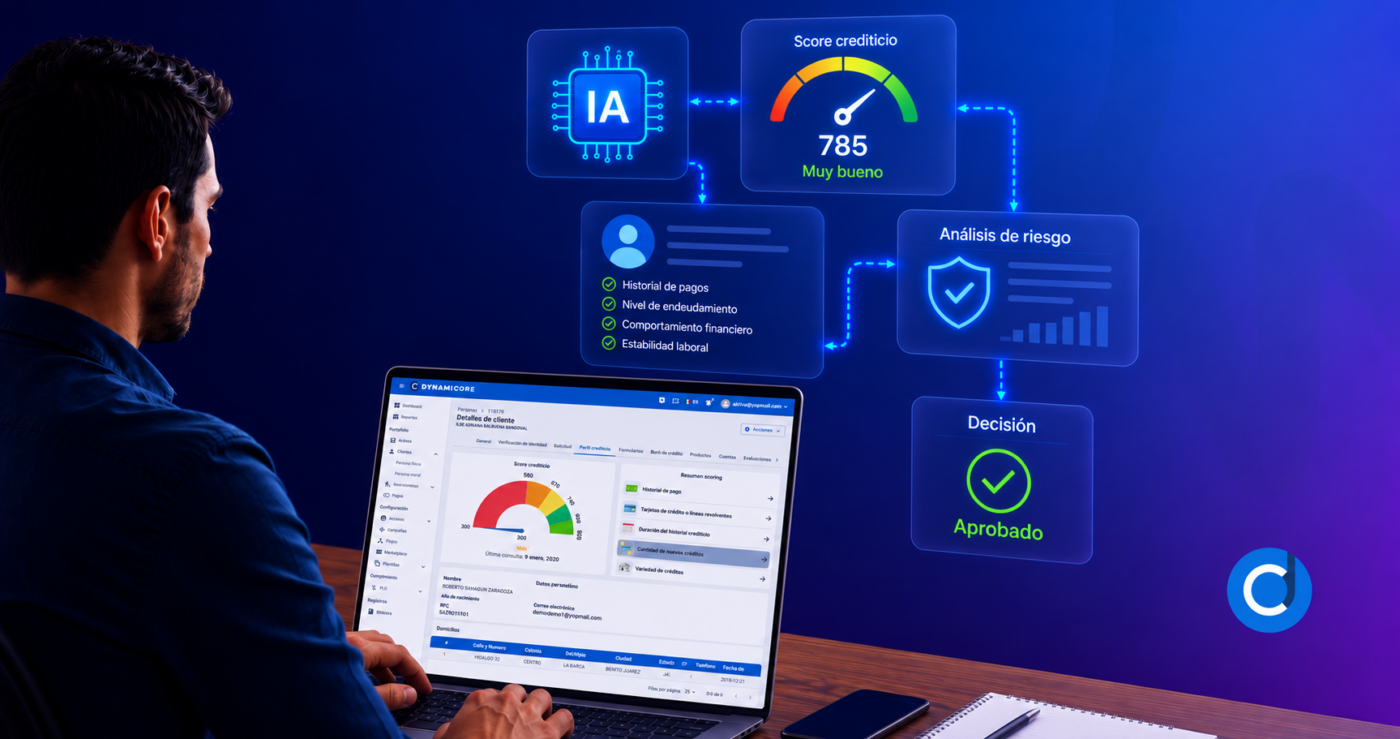
For decades, credit evaluation relied primarily on information from credit bureaus. These records remain important, but they can be insufficient when an applicant has a limited or nonexistent credit history.
Artificial intelligence helps address this gap through alternative credit scoring: a method that complements traditional evaluation with additional data sources and analytical models.
What is AI-powered credit assessment?
AI-powered credit assessment uses algorithms to process large volumes of information and identify patterns associated with a person’s financial behavior and repayment capacity.
Instead of relying on a single credit-history indicator, the model can evaluate multiple relevant variables—subject to applicable laws, consent requirements, data quality standards, and the institution’s risk policies—to provide a broader view of each applicant.
The result is not a replacement for responsible underwriting. It is an additional decision-support layer that can help financial institutions evaluate risk more consistently and efficiently.
How does AI credit assessment work?
1. Data collection and validation
The process begins with the credit application. Institutions may collect and validate information such as:
- Personal and identity information
- Official documentation
- Employment information
- Declared income
- Relevant financial information
Accurate data and identity verification are essential because model outputs are only as reliable as the information used.
2. Integration of relevant data sources
After identity verification, the system combines traditional credit information with other authorized and relevant variables. These sources must be evaluated for quality, consistency, privacy, and potential bias before they are used in decision-making.
3. Analysis with AI models
The model processes the available information to identify relationships associated with repayment behavior. It may recognize similarities among profiles or combinations of variables that have historically correlated with credit performance.
Institutions should monitor model performance over time and maintain documentation, explainability, and human oversight appropriate to the risk of each decision.
4. Generation of a recommendation
Once the analysis is complete, the system can generate a score or recommendation. Depending on the institution’s policies, the application may be approved automatically, declined, returned for additional information, or routed to manual review.
What is alternative credit scoring?
DynamiCore’s Alternative Score complements traditional credit assessment with authorized nontraditional information. Depending on the configured model and available data, relevant indicators can include employment stability, income consistency, recent financial behavior, transaction patterns, and other permitted digital information.
This approach can be especially useful for applicants with thin credit files, giving institutions additional context without depending exclusively on conventional credit history.
Benefits for financial institutions
More consistent decisions
Automated models apply defined criteria systematically, helping reduce unnecessary variation between evaluations.
Greater operational capacity
Automation allows teams to focus on complex cases that require specialized analysis.
Better assessment of thin-file applicants
Alternative data can provide additional insight when conventional credit information is limited.
Scalable processing
Institutions can evaluate more applications without increasing manual workload at the same rate.
Stronger risk management
Combining relevant variables, monitoring, and governance can support better-informed credit decisions.
The future of credit assessment
AI is expanding how financial institutions analyze credit risk, but effective adoption requires responsible data use, model validation, ongoing monitoring, and clear escalation paths.
DynamiCore’s banking core platform can incorporate alternative scoring into an integrated financial operation, helping institutions accelerate evaluation and broaden access while maintaining control over their credit policies.
Follow DynamiCore on Instagram, Facebook, and LinkedIn for more insights on financial innovation and automation.