 Digital Onboarding
  AML
AML  Credit Analysis
  Card Issuance
  Payment Dispersion
  Notifications
  Collections
  Bill Payment
  Alternative Scoring
  Device Lock
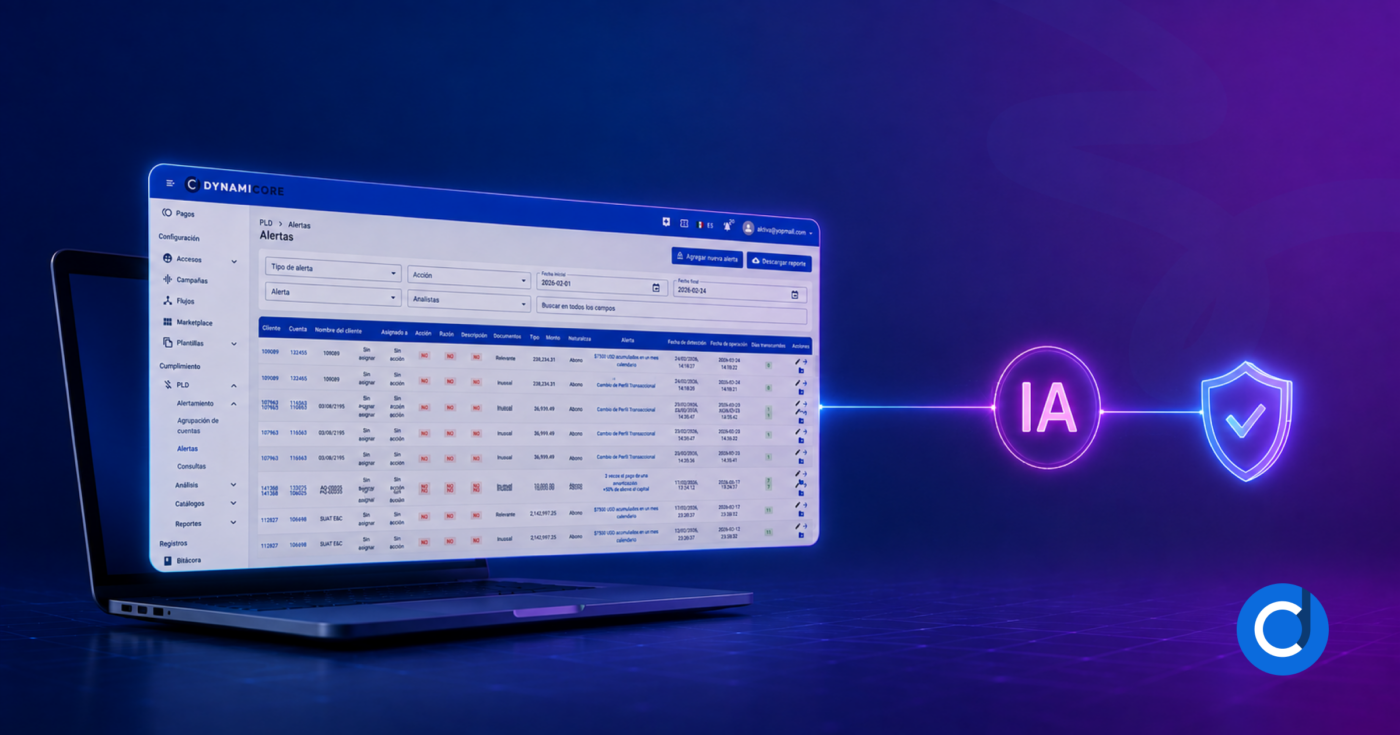
Artificial intelligence has transformed financial services by automating processes, detecting fraud in real time, assessing credit risk, and supporting customers through virtual assistants. These capabilities help reduce costs and improve the customer experience.
At the same time, AI has made financial fraud more sophisticated, requiring institutions to strengthen how they prevent and detect risk.
Deepfakes, voice cloning, synthetic documents, and artificially created identities make it increasingly difficult to distinguish legitimate interactions from fraudulent ones.
This creates a new challenge for fintech companies and financial institutions: controls designed to detect known patterns are no longer enough against threats that can evolve and generate false information at scale.
How can financial institutions address AI-driven fraud?
No single tool can solve the problem. An effective security strategy combines controls from digital onboarding through ongoing transaction monitoring.
1. Strengthen identity verification during onboarding
The first line of defense is to confirm that every application is connected to a legitimate identity.
A photo of an identification document is no longer sufficient when fraudsters can manipulate documents and generate synthetic content. Institutions should combine multiple verification layers:
- Document verification
- Biometric verification
- Liveness detection
- Know Your Customer (KYC) checks using the documents and identifiers required for each customer type and jurisdiction
- Screening against sanctions, national watchlists, United Nations lists, and politically exposed persons (PEP) databases
2. Extend prevention beyond account opening
A customer who successfully completes onboarding should not automatically be treated as low risk throughout the entire relationship.
Initial KYC must be complemented by continuous monitoring that can identify behavior inconsistent with the customer’s known profile.
The question should evolve from “Who is this customer?” to “Is the customer’s current behavior still consistent with what we know?”
This is especially important for compromised accounts, synthetic identities, and schemes in which a seemingly legitimate account is later used for illicit activity.
3. Connect risk signals
Risk increases when onboarding, AML compliance, fraud prevention, and transaction monitoring operate as isolated processes.
One signal may appear insignificant, but several related signals can reveal a meaningful risk pattern.
A change in transaction behavior combined with new counterparties, unusual activity, and recent profile changes may justify enhanced review.
Centralizing this information gives compliance teams a more complete view of risk and more context for investigating alerts.
4. Use a risk-based AML approach
Not every alert requires the same response.
An AML compliance platform should apply rules and criteria that classify customers and transactions by risk level, helping compliance teams focus resources on cases that require deeper analysis.
The goal is not to generate more alerts, but to generate relevant alerts with enough context to investigate them effectively.
5. Keep human oversight in critical decisions
Adding artificial intelligence to fraud and AML controls does not eliminate the need for human involvement.
Automated models can process large volumes of information, detect anomalies, and prioritize cases. Financial institutions still need human review, traceability, and escalation mechanisms for critical decisions.
Teams should be able to identify what triggered an alert, which information was analyzed, what decision was made, who intervened, and what evidence was recorded.
Automation should expand the team’s capabilities, not turn critical decisions into a black box.
Integrated fraud prevention for financial institutions
DynamiCore helps fintech companies and financial institutions integrate identity verification, continuous KYC and AML controls, monitoring rules, alerts, and traceability within one financial ecosystem.
This approach enables teams to identify risk signals earlier and maintain stronger control over compliance processes as AI-driven fraud schemes evolve.
Follow DynamiCore on Instagram, Facebook, and LinkedIn for more content on financial innovation, process automation, and technology for financial institutions.